B → τ ν
The Branching Ratio of B → τ ν can be used to determine
Rb=ρ2+
η2 independently from
the determination of Vub from semi-leptonic B decays. On the other side
not having used BR(B → τντ) as an input in the
analysis, we can indirectly determine its value as an output of our
fit. This is obtained starting from the UTangles determination of
ρ and
η, combined with the
experimental determination of Vub Vcb, adding
the experimental measurement of Δmd and Δms
to determine fB√BBd, and using the
lattice value of BBd=1.28 ± 0.05 ± 0.09
to obtain fB from it. In this way, the prediction is obtained
without using the value of fB taken from lattice calculations,
which has a larger relative uncertainty than BBd.
We obtain the values quoted below:
|
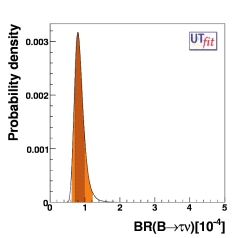
BR(B → τντ) = (0.85 ± 0.13) × 10-4
|
using all
the constraints available [All]
|
|
BR(B → τντ) = (0.87 ± 0.15) × 10-4
|
using all the constraints except
the exclusive value of Vub [Allincl]
|
|
BR(B → τντ) = (0.75 ± 0.11) × 10-4
|
using all the constraints except
the inclusive value of Vub [Allexcl]
|
Although all the predictions above are compatible within the errors,
a comparison of the values obtained from the above determinations gives the
measure of the correlation of this prediction with Vub
in the overall UT fit, since all other input quantities are the same.
The result p.d.f., obtained using all the informations in the fit,
is given in the plot below.
For comparison, using fB value from LQCD (fB = (189 ± 27) MeV)
and the inclusive determination of Vub
(Vub = (44.9 ± 3.3) × 10-4), one would obtain
BR(B → τντ)=(1.39 ± 0.44) × 10-4.
Note that in this case, contrary to the case of Δ ms,
a better agreement between the prediction and the experimental world average
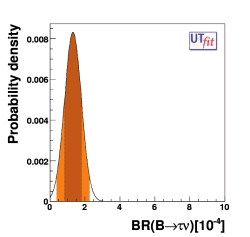
(BR(B → τντ)=(1.31 ± 0.48) ×
10-4, combining Belle and BaBar) is found when the inclusive value of
Vub. This suggests that the experiemental measurement is in agreement
with the value of the inclusive determination of Vub.
This Branching Ratio depends upon |Vub|2 and the B decay constant fB.
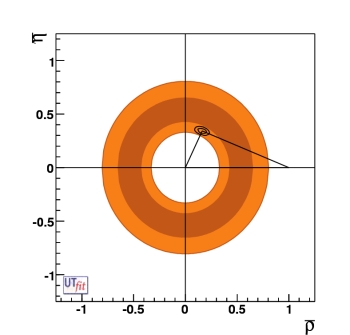
We show here the bound on the
(ρ;
η) plane (giving the
total UT fit result as a reference), obtained using the experimental
measurements from
BaBar
(BR(B → τν) = 0.88+0.68+0.11-0.67-0.11)x10-4)
Belle
(BR(B → τν) = 1.79+0.56+0.39-0.49-0.46)x10-4)
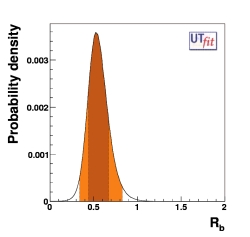
translated into a bound on Rb.
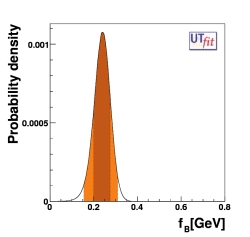
An other interesting exercise
consists in assuming the output of the UT analysis and translate
the measurement of the Branching Fraction into a determination of
fB, to be compared to Lattice calculations.
(EPS)
[JPG]
|
Experimental likelihood of B → τ ν
BR(B → τ ν) = (1.31 ± 0.48)10-4
([0.38,2.25] @ 95% prob.)
|
|
(EPS)
[JPG]
|
bound from B → τ ν on the
(ρ;
η) plane
|
|
(EPS)
[JPG]
|
1D p.d.f. of Rb from B → τ ν
Rb = 0.55 ± 0.11
([0.34,0.83] @95% Prob.)
|
|
(EPS)
[JPG]
|
1D p.d.f. of fB from B → τ ν
fB = 0.237 ± 0.037 GeV from the exp+UTfit
fB = 0.189 ± 0.027 GeV Lattice QCD
|
|

![[JPG]](btaunu_nofbSM.jpg)
![[JPG]](btaunu_lik.jpg)
![[JPG]](b2taunu.jpg)
![[JPG]](btaunu_Rb.jpg)
![[JPG]](btaunu_fB.jpg)